
Boat Flare Requirements | Everything You Need To Know
It surprises some boaters to discover that strict regulations apply, particularly regarding the safety equipment they carry on board.
All requirements are very reasonable and will be appreciated in an emergency situation where help is needed.
In this article, we discuss the legislative requirements for carrying distress flares. We also describe each of the categories of flares as defined in the legislation.
A few exceptions include vessels used in inland waters, less than 1 mile from the shore, and boats used in organized events.
Before we begin, it’s worth noting that all powerboats over 16 feet and sailboats over 20 feet are required to carry visual distress signals.
Are Flares Required To Be Carried By All Vessels?
Several regulatory bodies ensure boating safety standards.
The COLREGs (the 1972 Convention On The International Regulations For Preventing Collisions At Sea) and SOLAS (The International Safety Of Life At Sea) – cover sailing in international waters.
The U.S. government and states enact laws and regulations to enforce safety standards, and the United States Coast Guard is responsible for enforcing compliance.
The regulations require different quantities of flares to be carried according to the size of the boat.
| Must have a watertight flashlight | Length | Required Distress Signal Devices | Additional Requirements |
|---|---|---|---|
| Pleasure Craft (Powered by Motor) | Under 19.7 Feet | 3 x Type A, B, C, or D devices (Not exceeding one type D) | Alternatively, a watertight flashlight |
| Sailing Boats/Engine Powered Boats | 19.7 Feet – 29.5 Feet | 6 x Type A, B, C, or D devices (No more than 2 of type D) | Must have a watertight flashlight |
| Sailing Boats/Engine Powered Boats | 29.5 Feet – 39.4 Feet | 12 x Type A, B, C, or D devices (No more than 6 of type D) | Must have a watertight flashlight |
| Sailing Boats/Engine Powered Boats | 39.4 Feet – 78.7 Feet | Combination of 12 type A, B, C, or D flares (No more than 6 of type D) | Must have a watertight flashlig |
Pleasure vessels are not required to comply with these requirements under the following circumstances,
1️⃣ The boat is not operated more than 1 nautical mile (1.852 km) from the shore when the boating is on a river, canal, or lake.
2️⃣ The boat has no accommodation designed to be slept in whilst participating in or preparing for an official competition.
3️⃣ If the pleasure craft is less than 20 feet long (6 meters) and is equipped with two-way radio communication, a personal locator beacon, or an Emergency Position Indicating Radio Beacon transmitting on 406 MHz, the number of flares can be reduced by ½. Remember that the number of Class D flares can never be more than 50% of the total.
4️⃣ Manually propelled boats are not required to carry any flares.

Acceptable Signaling Equipment
There are two types of signaling equipment authorized under regulations.
Pyrotechnic Signals are required to comply with the minimum SOLAS Pyrotechnic Signals performance standards. The most important of these are detailed below, under the description of each type of device.
Triggering these devices initiates an exothermic (heat) chemical reaction, which releases energy into the surrounding environment in one of the following (or a combination of) forms.
Pyrotechnic Distress Signals include the following four categories.
| Device Type | Description |
|---|---|
| Type A | Rocket parachute or gun-style parachute flares |
| Type B | Multi-star flares |
| Type C | Handheld flares |
| Type D | Smoke signals |
Type A Devices Rocket Parachute Flares

These aerial flares create a bright red light that must reach a minimum height of 1,000 feet (300m) above the vessel.
The device is activated by the user pointing it to the sky (outside the cabin) and removing the safety cap at the bottom of the device.
This reveals the trigger (normally a piece of string). The string is pulled, which causes the rocket “motor” to fire. The rocket exits the container and shoots skywards.
A parachute deploys at the apogee (the highest point of its travel), which slows the rocket’s descent (SOLAS regulations stipulate that the descent rate must be less than 5.1 m/s), providing the red distress flare above the vessel.
They usually burn for 60 seconds (SOLAS regulations stipulate a 40-second burn time) and, depending on conditions, are visible up to 10 miles during the day and 40 miles at night.
Gun Style Parachute Flares

The only difference between the gun and rocket-style flares is in the method of launching. The gun (pistol) style launchers are made from plastic.
When the flare is fired from the gun, it only ignites at the apogee while simultaneously deploying the parachute.
Type B Devices: Multi-Star Flares

Type C Devices: Hand-Held Flares
The multi-start flares fire two projectiles into the air to a height (product brand dependent) of between 100 to 320 feet.
They burn for approximately 5 seconds. These create two bright lights in the sky.

Handheld flares are similar to the fireworks called Roman candles. The difference is that they are safe to hold, and the ignition is caused by an exothermic chemical reaction.
Type C devices produce a bright red flame (SOLAS regulations stipulate a minimum luminous intensity of not less than 15,000 cd), which, although they cannot be seen from far away, is an excellent aid to help searchers locate the user.
SOLAS requires flares to burn for at least 60 seconds and must continue burning even if they are immersed for 10s underwater to a depth of 100 mm.
Red flares can be seen at night.
Type D Devices: Smoke Signals

Smoke signals are typically handheld but also called orange smoke distress signals when they are buoyant.
Type D devices produce a bright orange smoke plume which, amongst other uses, can be used to show the wind direction to rescuers.
The devices are manufactured as handheld units (similar to the handheld flares), and floatable smoke dispensers launched onto the water.
SOLAS requires they must continue to operate even if they are immersed for 10s underwater to a depth of 100 mm.
There are two categories of smoke signals regulated by SOLAS.
1️⃣ Buoyant (3-min) smoke signals are required to produce smoke for 3 minutes.
2️⃣ Self-Activating Smoke Signals, which must continue to generate a “highly visible color” smoke plume for up to 15 minutes.

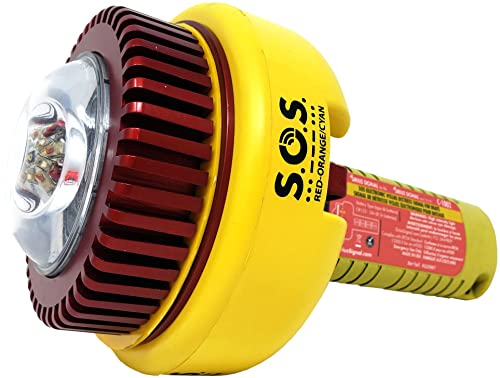
As the name implies, Non-Pyrotechnic Signals are passive devices that produce no chemical reaction. Electronic distress flares can be used in place of pyrotechnics where approved.
There are many types of marine emergency beacons that include but are not limited to the following: